
Rebuilding the Backbone: APEX Compressor Executes a High-Stakes System Overhaul for a Northeast Iowa Manufacturer
It All Begins Here
In manufacturing, compressed air is often called the fourth utility—critical, constant, and too often overlooked until something goes wrong.
For one major manufacturer in Northeast Iowa, that moment had arrived.
Years of incremental expansion had left the facility with a patchwork compressed air system—multiple brands of equipment, varying ages, and inconsistent performance. Some machines had exceeded their intended lifespan, while others were failing prematurely. Reliability was slipping, efficiency was lagging, and the system as a whole lacked cohesion.
Adding to the challenge, the entire compressor room was located on a second level—turning what would already be a complex replacement into a logistical puzzle involving rigging, demolition, and tight installation constraints.
Rather than applying another temporary fix, the manufacturer partnered with APEX Compressor to take a different approach: start with the data, and build the system the right way.
From Assumptions to Data-Driven Design
Before recommending equipment, APEX initiated a comprehensive compressed air audit designed to uncover how the system was actually operating—not how it was assumed to operate.
Using hot tapped flow meters, power monitoring, and pressure sensors, the team collected high-resolution, sequential data over time. This allowed APEX to understand true demand profiles, system dynamics, and inefficiencies that would otherwise remain hidden.
The result was clarity.
Instead of relying on nameplate capacities or historical guesses, APEX designed a system based on real operating conditions—ensuring the final solution would maximize efficiency while improving reliability and incorporating built-in redundancy.
But data alone wasn’t enough.
To eliminate surprises during installation, APEX developed a full 3D rendering of the compressor room. This digital model allowed the team to identify and resolve potential conflicts in advance, including electrical conduit routing, water main interference, and fire sprinkler obstructions.
By addressing these challenges before stepping on site, the project was planned down to the fitting level—giving the field team a clear, executable roadmap.
A Full-System Reset
With a clear understanding of the system’s needs, APEX and the customer aligned on the most effective path forward: a complete compressor room replacement.
The scope was extensive. Five existing compressors, two dryers, receiver tanks, and all legacy piping and electrical infrastructure were removed.
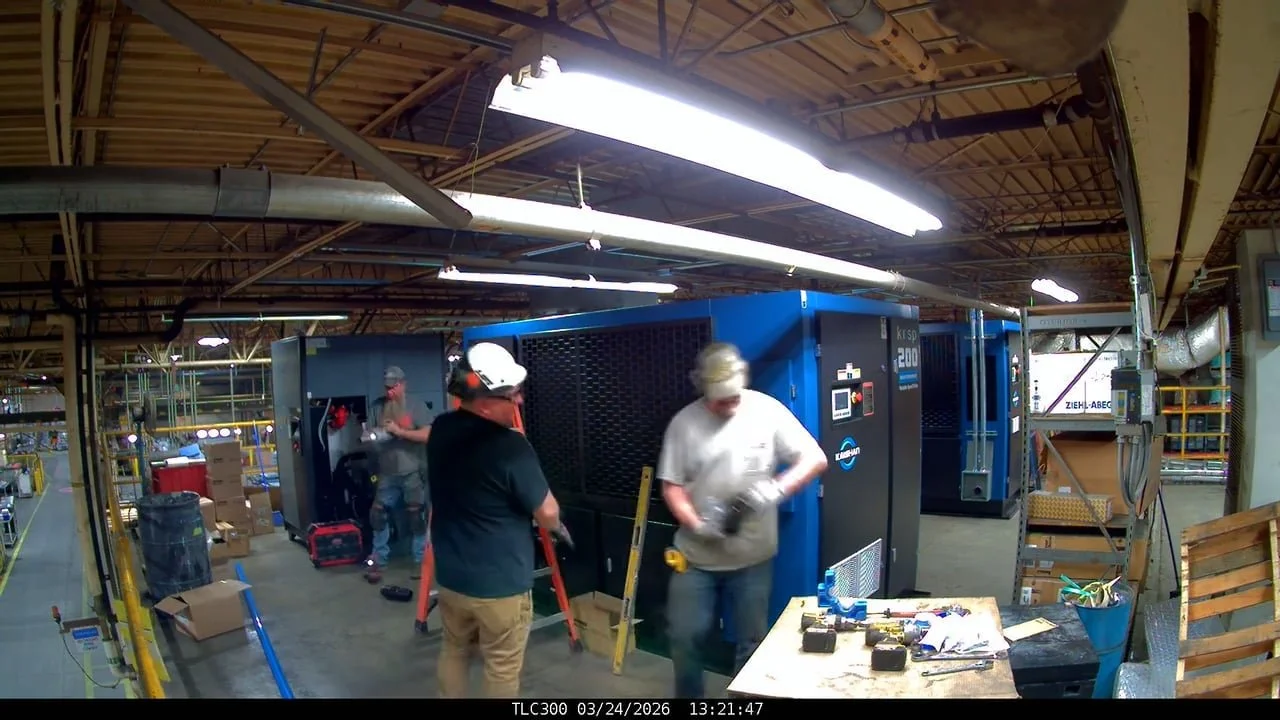
In their place, APEX installed a clean, modern system centered around four 200 HP Kaishan KRSP-200 compressors, paired with two Mikropor refrigerated dryers with integral filtration. The new layout emphasized simplicity, serviceability, and long-term reliability—eliminating the inefficiencies and inconsistencies of the previous system.
Executing Without Interruption
For a critical manufacturing facility, downtime is not an option.
To ensure continuous production, APEX implemented a fully managed temporary air solution. Portable diesel compressors were installed to carry the plant load, along with a backup unit to eliminate risk in the event of equipment failure.
A carefully planned Sunday outage allowed the team to complete critical tie-ins and electrical work on the main bus. By Monday morning, the temporary system was fully operational—and the transformation began.
Over the course of the week, APEX crews executed a complete demolition and rebuild of the compressor room. Equipment was rigged out and replaced, new piping was installed using Parker Hannifin’s Transair modular aluminum system, and best-practice layouts were implemented throughout.
The use of modular piping significantly accelerated installation while improving long-term performance. Bypass provisions were built in around air treatment equipment, ensuring future service could be completed without disrupting operations.
Ventilation was also reimagined. Compressor ducting was installed to remove heat from the building during warmer months, while a recirculation system allows that heat to be reused in the winter—reducing both energy costs and environmental impact.
Speed, Precision, and Results
From the initial purchase order to full system startup, the entire project was completed in just 35 calendar days. On-site execution—from shutdown to operational—was completed in a single work week.
Most importantly, production was never interrupted.
Today, the facility operates with a fully modern compressed air system designed for performance, reliability, and visibility. Built-in redundancy ensures consistent operation, while remote monitoring through Kaishan’s AirWatch platform provides real-time insights and alerts.
What was once a fragmented and aging system is now a streamlined, high-performance utility—engineered with precision and built to last.
A Model for What’s Possible
Projects like this highlight a shift in how compressed air systems are approached.
Rather than reacting to failure, forward-thinking manufacturers are investing in data, design, and execution—treating compressed air not as an afterthought, but as a critical piece of infrastructure.
For APEX Compressor, that philosophy is simple: measure first, design with intent, and execute without compromise.
Because when done right, compressed air doesn’t just support production—it strengthens it.